Tuesday, October 19, 2010

The Most Sex Cities in the World

Sex City Pattaya

Pattaya is a paradise of sex ternyaman in the world. Naturally, the show sex and transsexual cabaret is a tourist anglers are legal in the coastal city located in the Gulf of Thailand, southeast of Bangkok. No need to wait for the night if you want to spend time with prostitutes.
Those 24 hours can be found and invited to dating. There is also the beautiful transvestites circulating along the tour route. Bored with sex, just watch Thai Boxing in a number of bars.


Amsterdam City of  Mariyuana


Amsterdam, the Netherlands, has dozens of cafes marijuana, one type of drug. Marijuana, cigarettes, and the like are legal in this country windmills. There is no rule which states that objects should be used with certain procedures.
Want a date with a prostitute? Simply go to the district in one part of town. There, you can view and select the desired woman from the window glass. The prostitutes will be styled with or without clothes like a doll display. The victory also felt same-sex lovers. They can freely pledge that relationship, because there is no prohibition for the love of this kind. For those who do not believe in God, no question about it in Amsterdam.


Manama Glamour City


Welcome to the Feast of Oasis Middle East. The phrase is that you will receive on arrival in Manama, Bahrain, an area adjacent to Saudi Arabia. If during the rule of the Saudi Arabian Government is very tight rein citizens and visitors, in Manama all can be negotiated.
Want to clubbing all day, or partying sex? In Manama legitimate. Indeed the city was known as one of the largest Muslim population in the desert region. But in 2001 the city is being more liberal. Residents also began to arrive on the association of the West.


Las Vegas gambler paradise


Las Vegas gamblers paradise. Everyone can gamble day and night, even when he was at the airport. Almost all regions in Las Vegas providing gambling sites. Although not yet fully legal, prostitution has also long been a power tarikyang accompany the activities in the casino.
The best part of this city, regardless of cultural background pendatangnya, Las Vegas remains the best haven in the United States. "Go On and Sin", that's industriyang managed here.


Rio de Janeiro  Topless City


Brazilian women have a charm of incredible beauty. No wonder the world's top supermodels come from here. Rio de Janeiro is one of the city that holds the comeliness of the body. Try and visit the beaches there, not a few topless women topless alias and-thatch jokingly jolly.
The atmosphere was getting wild when the sun set on the corner of the beach. A number of brothels on the beach ready to spoil the appetite of Adam. Do not be surprised, prostitution is legal in this city. 

City of Clubbing

What happens when the state changed the face of communal? The people would have hysteria. That is now happening in Moscow, Russia. Each club night there playing hardcore techno music to rock. Almost all young children Moscow, spent time at the club.
If you want to get a date express, almost all clubs to provide this service. Just try to striptease clubs near Red Square. There is also The Hungry Duck, a bar that held a ladies' night three times a week and male stripper for 24 hours. Prostitution was banned in Moscow, but can still be done by stealth.

Friday, October 15, 2010

Russian Wooden Cellphone


Russian Wooden Cellphone

Russian Wooden phone with a bottle opener 1
If every country had it’s own type of cellphones, Russian ones could look like this. It could be made of wood - wood is cheap and is available everywhere in Russia, it has simple functions like call and bye, it would be made in Finland cause everyone in Russia knows good phones are made in Finland (like Nokia!) and one additional option is a must - a beer bottle opener from the backside of the phone - very handy!


Russian Wooden phone with a bottle opener 2
Russian Wooden phone with a bottle opener 3
Russian Wooden phone with a bottle opener 4
Russian Wooden phone with a bottle opener 5
via lobzik.pri.ee

Some off-roading can border on suicide.

Some off-roading can border on suicide.

Don't get me wrong, I own a Jeep and will go off road with the first opportunity. However, some of the following shots stretch the realms of possibility and can be deemed either Photoshop or "simply nuts".

We'll start with the Hummers climbing exercise on The Lions Back, Moab, Utah:
(found on Pic.Tiexue.net, pictures courtesy The Hummer Network, photographer Bill Damm)

travel, adventure

travel, adventure

travel, adventure

travel, adventure

For the first person perspective going down, click here


Scary roads do not get "better" than this:
Carhuaz Valley road in Peru on the way to Chavin De Huantar ruins.

travel, adventure


travel, adventure
(images credit: Terrax)


Meanwhile in the US mountains...
Flat Iron Mesa in Moab, Utah:

travel, adventure
(image credit: Whitey)


Black Bear Pass, Colorado

travel, adventure
(images credit: RJsfun)


Webster Pass - top shelf road:

travel, adventure


Schofield Pass - Devil's punchbowl with snow:

travel, adventure


Cliffhanger - Moab, Utah:

travel, adventure
(images credit: RJsfun)

"The Cliffhanger is the worst feeling because it's less than 3' to a very very long freefall."


Santa Fe Peak, Colorado, and switchback road near the top of Mt. Antero:

travel, adventure


travel, adventure
(images credit: Octoberist)


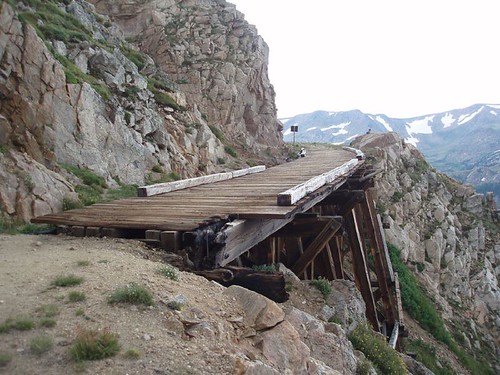
Bridge at the Rollins Pass:

travel, adventure

Looking down when driving across the bridge:


(images credit: ArloGuthroJeep - updated info)


Shelf road on Radical Hill:

travel, adventure
(image credit: DaJudge)


And probably the hairiest of all -
Negotiating top of the Pearl Pass, Colorado, in a thunderstorm:

travel, adventure
(images credit: 86Original)

Send us your own scary / exciting extreme off-roading pictures, for the next adrenalin-charges post.

Off-roading's Humble Beginnings

The 20s had more mud and fewer roads, of course.

travel, adventure

Also Read: Most Dangerous Roads in the World, Parts 1-4

Keep up the off-roading fun with Jeep Accessories from AutoAnything. We've got all the auto parts you'll need to take on the most barren landscape. Get yourself covered up with Bestop or get some Truck Seat Covers!

Tuesday, October 12, 2010

Hotel 626: the Online Haunted House

Hotel 626: the Online Haunted House

Share552

Frito-Lay of North America presents a Snack Strong production that you won't soon forget.  This truly unique and innovative use of multiple online medias is a really cool experience (especially if you like scary movies and such).  The site, Hotel 626, requires you to use a webcam, a microphone, and register with the site so that they can immerse you properly into this hellish nightmare.  Don't worry it's not that hellish.  In fact, it's pretty fun!
The site runs entirely on flash, and utilizes your webcam to make sure you're playing in the proper conditions, namely with all the lights turned off.  As a bonus, Hotel 626 is only open at night time, from 6pm to 6am, so you won't be getting out of the creepy factor too easily.

After you register with the site, you'll be allowed to enter Hotel 626, which starts off with a disturbing jump out of bed due to some strange noises.   The game is played in 10 chapters, most of which utilize some form of media interaction.  You have to pay attention very carefully for clues in the cinematic scenes that will let you solve puzzles and survive the horror.  One stage tells you to flash a goul with your on-screen camera, one asks you to sing a lullabye, and one requires you to sift through pictures until you find your own.  There's also one part with a creepy phone call that will help you escape Hotel 626, so make sure you have your cell nearby.

There aren't many sites that take full advantage of different types of interactive online media the way Hotel 626 does.  It really is a fun and challenging game, and if you make it all the way to the end, you can even share your journey on Facebook and Twitter.  After work tonight, definitely check this one out.  You'll be impressed with how well this site works, and how engaging the game becomes.
Austin Keenan
Innovative Gadgets, Technology and Websites
InventorSpot.com

10 Most Unique sink


1. Splash Sink
https://blogger.googleusercontent.com/img/b/R29vZ2xl/AVvXsEiC0HhKjv72OZk5x3WS-RSzelvsMeJHtnS-zQxZN-Yoq0d_0eiUisBVkcJMOch7RuEBq1GjXYw2lWfx9IPTALDUBuz4AznVxzHzT4K9pJwV2tvucy1U76jhjnpMKjh96E49Rcghhmo3d5k/s1600/a97209_g140_6-splashing.jpg

2. Poor Little Fish Sink
https://blogger.googleusercontent.com/img/b/R29vZ2xl/AVvXsEglVImyGpt08DhD6d5oVn2t2LftBqJ0bG3c-rjSxWUAKI4ggOBxN-uQxH-tCeYzU6RW4NQmMc-nLtppZolxwjjoVqVnn7TUo3Ki6vp6NRkIAUSSVfYzdzFNahSAf04YsZ2rNkro1HXZnWY/s1600/a97209_g140_1-fish-sink.jpg

3. Waterfall Sink
https://blogger.googleusercontent.com/img/b/R29vZ2xl/AVvXsEi_EQT5NVbt1MxdKx0enjf-CzV4zLHnp9KGRI7sx1bKctaNw7HkKFDG0ktBLp-t2-CTvK5IPKHE6XtkSf0H2kJfuYinJJQk1dF4lvZaqseBhC0AjcmPNVGGskH8uP-_-9MG4-f3rtgoPg0/s1600/a97209_g140_8-waterfall.jpg

4. Sperm Shaped Sink
https://blogger.googleusercontent.com/img/b/R29vZ2xl/AVvXsEicdKlLBaqYVQ83wfqCbhCVLvXoInzlMqZGuK0f1UZnLqOJH92KObBGR0YjVP2BDErwUOWFy8cZfRE_36v3_NdPI_2xDCHCAVvZNczUfxFp1Mr14kRK8s4bTA0LjLfod3fPobJlJbSLKyM/s1600/a97209_g140_4-sperm.jpg

5. Martini Sink
https://blogger.googleusercontent.com/img/b/R29vZ2xl/AVvXsEhVw3upnygc-7o0T8ytXrw-vs9EOFdcJL9sT6nWkrCIwSenbj81bsQVZmR8m69Zb_NOaekD5fwv4l42B5csS1msFRKXZ075C4Mxr98TRm1bdWv7vDGBnQWlPRPjaLjkg23SW-nw4To43jI/s1600/a97209_g140_2-cocktail.jpg

6. Crevasse Prep Sink
https://blogger.googleusercontent.com/img/b/R29vZ2xl/AVvXsEicbTEhNYpmNnMCv1a7kPQWphHoGg3EJnCDipXg5-hKm3_LWUkI6D2g2Xt0OSPHpT_mzK0bBxt6lYyg0KhXUMzfjKgVGvr3Pb_hJI5qQ68v-ELmgUuc_xOe_vcFkZqrG-6V76scXdcROhU/s1600/a97209_g140_3-prep-sink.jpg

7. Foglio Sink
https://blogger.googleusercontent.com/img/b/R29vZ2xl/AVvXsEinDU_f2aQYbV86raVSChgyd66OF1gB_mox7PvdM55r580dE_-I66xaVaE3qnbxTzE4s5DujLiFwNYwnOqGrgh1Cea3rRbfn9fvGcBoK7L4LuJ-fgt7Vr7io6ovv79e9W9tyoFPSxmWc6E/s1600/a97209_g140_7-brazilian.jpg

8. Soccer Sink
https://blogger.googleusercontent.com/img/b/R29vZ2xl/AVvXsEhCu4v85bN0APyyG5Heb4Q3l3-e-A1Q4Uv-CyK-4yz84V9TUk5Y7gd1fFUwS5MlkF9I4l2dQz9hUre27PmfKubIyMz-TX9MK8sRBnWQhQhSYqoMH5CV2WCRuepWn8AhyPbFl58GCVXw35s/s1600/a97209_g140_9-soccer.jpg

9. Ripple Faucet and Sink
https://blogger.googleusercontent.com/img/b/R29vZ2xl/AVvXsEi2Z-EtKxm-TauhVu8USL1hgyitses0oVaMwXVr59vOTdP0X-kr_7suY-vBOeYatgbtTElI8w6ARowlSTOAOy0XngeeqJfdnMPN8GIMOt_Z8QhUYxdsfkP-9_HT3FcEeNtx8V6HjQMVM90/s1600/a97209_g140_5-ripple.jpg

10. Tire Sink
https://blogger.googleusercontent.com/img/b/R29vZ2xl/AVvXsEjjBwfvFx_igN5FpI2JGnOAJqC6r0aX-HqS2-HbzISrA7ncUt0zUWBDpBEsNOwUZQMh8GYgtGNzcxp2oP3-TDkPs93BvGsJqeWe4jdmm284s0O0oRMfSyUMjPuQfmhARBqosQh8XgVCVvY/s1600/a97209_g140_10-tire.jpg
Unikboss

Monday, October 11, 2010

New carnivorous mammal species found in Madagascar

New carnivorous mammal species found in Madagascar
By Victoria Gill
Science and nature reporter, BBC News

Newly discovered carnivorous mammal, Durrell's vontsira
Scientists first caught the live specimen in 2005
A new species of carnivorous mammal has been discovered in Madagascar.
The mongoose-like creature has been called Durrell's vontsira (Salanoia durrelli) in honour of conservationist Gerald Durrell.
Scientists found the creature in the wetlands of Lake Alaotra, the largest lake in Madagascar.
Its marsh habitat is under pressure from invasive species and pollution, and the team thinks it could be one of the world's most threatened mammals.
They describe the cat-sized animal for the first time in the journal Systematics and Biodiversity.
A team from the Durrell Wildlife Conservation Trust first saw the mammal swimming in the lake during a field trip in 2004. Suspecting it might be a new species, they photographed it so their zoologist colleagues could examine it more closely.
A team then returned to the site in 2005, caught one of the animals and took detailed measurements and blood and tissue samples.
During the same expedition, the scientists sent one dead specimen to the Natural History Museum in London.
There, zoologists were able to compare the creature with its closest relative, the forest-dwelling brown-tailed vontsira, and finally confirm its identity.
Durrell's vontsira and the brown-tailed vontsira are similar but have very different colouring, explained the Natural History Museum's Dr Paula Jenkins, a member of the research team.
Lake Alaotra, Madagascar, where a new species of carnivorous mammal has been discovered
Scientists think the animal lives in the wetlands of Lake Alaotra

"In addition, we found obvious differences in the structure of the skull and teeth... the size and shape of the pads on the paws clearly distinguished this animal from the brown-tailed vontsira, which is a forest-dwelling animal found in eastern Madagascar.
"It was indeed a distinct new species and the specimen we have in the museum is now recognised as the holotype (the specimen from which the species takes its name) so it is available to scientists for research in the future."
'Incredibly rare'
The discovery of mammal species is uncommon and finding a new carnivore species is "particularly unusual", Dr Jenkins added.
"Durrell's vontsira is incredibly rare," she said.
"We know of only two animals in the wild. It has only been found in the wetlands of [Lake] Alaotra in Madagascar, so it lives in a very small area and is consequently vulnerable to the pressures on this threatened habitat."
Marshes around Lake Alaotra in Madagascar
The creature may be adapted to a semi-aquatic habitat
The researchers still know very little about the animal's behaviour and biology.
They think it may be a mongoose-like creature specifically adapted for an aquatic or semi-aquatic environment.
Professor John Fa, chief conservation officer at Durrell, told BBC News: "If that is the case, it's very interesting indeed; mongooses normally live in arid or forested areas.
"We think it feeds on fish and small mammals in the lake and if it's a mongoose that catches fish - that's very unusual."
The scientists hope to return to the lake to carry out a more detailed, systematic trapping study, and possibly to tag and follow the small mammals to see if their habitat is confined to the lake.
"This just shows how much biodiversity Madagascar is still throwing at us," Professor Fa added.
Since 2006, new mammal species found in this biodiversity hotspot have included three new species of mouse lemur (Microcebus jollyae, M. mittermeieri and M. simmoni) and a bat (Scotophilus marovaza).
But the last carnivore discovered on the island was Grandider's vontsira (Galidictis grandidieri), described in 1986.
It is classified as Endangered on The IUCN Red List.
The team also included researchers from Nature Heritage in Jersey and Conservation International (CI).

10 things you didn't know about sound

October 10, 2010 -- Updated 1700 GMT (0100 HKT)
Click to play
Shh! Make your life sound better
STORY HIGHLIGHTS
  • Julian Treasure: Sounds we hear have an important effect on our lives and health
  • Noise can cause physical harm and sound can heal, he says
  • He says headphone abuse is creating deaf kids
  • More research needed to fully understand how what we hear affects our health, he says
Editor's note: TED is a nonprofit organization devoted to "Ideas worth spreading," which it makes available through talks posted on its website. Julian Treasure, the author of "Sound Business," is chairman of UK-based audio branding specialist The Sound Agency and an international speaker on sound's effects on people, on business and on society.
(CNN) -- Most of us have become so used to suppressing noise that we don't think much about what we're hearing, or about how we listen. Yet our well-being is now being seriously damaged by modern sound. Here are 10 things about sound and health that you may not know:
1.) You are a chord. This is obvious from physics, though it's admittedly somewhat metaphorical to call the combined rhythms and vibrations within a human being a chord, which we usually understand to be an aesthetically pleasant audible collection of tones. But "the fundamental characteristic of nature is periodic functioning in frequency, or musical pitch," according to C.T. Eagle. Matter is vibrating energy; therefore, we are a collection of vibrations of many kinds, which can be considered a chord.
2.) One definition of health may be that that chord is in complete harmony. The World Health Organization defines health as "a state of complete physical, mental, and social well-being and not merely the absence of disease or infirmity" which opens at least three dimensions to the concept. On a philosophical level, Plato, Socrates, Pythagoras and Confucius all wrote at length about the relationship between harmony, music and health (both social and physical). Here's Socrates: "Rhythm and harmony find their way into the inward places of the soul, on which they mightily fasten, imparting grace, and making the soul of him who is rightly educated graceful, or of him who is ill-educated ungraceful."
Watch an interview with Julian Treasure
3.) We see one octave; we hear ten. An octave is a doubling in frequency. The visual spectrum in frequency terms is 400-790 THz, so it's just under one octave. Humans with great hearing can hear from 20 Hz to 20 KHz, which is ten octaves.
Video: Julian Treasure: Making life sound better
4.) We adopt listening positions. Listening positions are a useful set of perspectives that can help people to be more conscious and effective in communication -- because expert listening can be just as powerful as speaking. For example, men typically adopt a reductive listening position, listening for something, often a point or solution.
Women, by contrast, typically adopt an expansive listening position, enjoying the journey, going with the flow. When unconscious, this mismatch causes a lot of arguments.
Other listening positions include judgmental (or critical), active (or reflective), passive (or meditative) and so on. Some are well known and widely used; for example, active listening is trained into many therapists, counselors and educators.
5.) Noise harms and even kills. There is now wealth of evidence about the harmful effect of noise, and yet most people still consider noise a local matter, not the major global issue it has become.
According to a 1999 U.S. Census report, Americans named noise as the number one problem in neighborhoods. Of the households surveyed, 11.3 percent stated that street or traffic noise was bothersome, and 4.4 percent said it was so bad that they wanted to move. More Americans are bothered by noise than by crime, odors and other problems listed under "other bothersome conditions."
TED.com: Music is medicine, music is sanity
The European Union says: "Around 20% of the Union's population or close on 80 million people suffer from noise levels that scientists and health experts consider to be unacceptable, where most people become annoyed, where sleep is disturbed and where adverse health effects are to be feared. An additional 170 million citizens are living in so-called 'grey areas' where the noise levels are such to cause serious annoyance during the daytime."
The World Health Organization says: "Traffic noise alone is harming the health of almost every third person in the WHO European Region. One in five Europeans is regularly exposed to sound levels at night that could significantly damage health."
The WHO is also the source for the startling statistic about noise killing 200,000 people a year. Its findings (LARES report) estimate that 3 percent of deaths from ischemic heart disease result from long-term exposure to noise. With 7 million deaths a year globally, that means 210,000 people are dying of noise every year.
TED.com: Jose Abreu on kids transformed by music
The cost of noise to society is astronomical. The EU again: "Present economic estimates of the annual damage in the EU due to environmental noise range from EUR 13 billion to 38 billion. Elements that contribute are a reduction of housing prices, medical costs, reduced possibilities of land use and cost of lost labour days." (Future Noise Policy European Commission Green Paper 1996).
Then there is the effect of noise on social behavior. The U.S. report "Noise and its effects" (Administrative Conference of the United States, Alice Suter, 1991) says: "Even moderate noise levels can increase anxiety, decrease the incidence of helping behavior, and increase the risk of hostile behavior in experimental subjects. These effects may, to some extent, help explain the "dehumanization" of today's urban environment."
Perhaps Confucius and Socrates have a point.
6.) Schizophonia is unhealthy. "Schizophonia" describes a state where what you hear and what you see are unrelated. The word was coined by the great Canadian audiologist Murray Schafer and was intended to communicate unhealthiness. Schafer explains: "I coined the term schizophonia intending it to be a nervous word. Related to schizophrenia, I wanted it to convey the same sense of aberration and drama."
My assertion that continual schizophonia is unhealthy is a hypothesis that science could and should test, both at personal and also a social level. You have only to consider the bizarre jollity of train carriages now -- full of lively conversation but none of it with anyone else in the carriage -- to entertain the possibility that this is somehow unnatural. Old-style silence at least had the virtue of being an honest lack of connection with those around us. Now we ignore our neighbors, merrily discussing intimate details of our lives as if the people around us simply don't exist. Surely this is not a positive social phenomenon.
7. Compressed music makes you tired. However clever the technology and the psychoacoustic algorithms applied, there are many issues with data compression of music, as discussed in this excellent article by Robert Harley back in 1991. My assertion that listening to highly compressed music makes people tired and irritable is based on personal and anecdotal experience - again it's one that I hope will be tested by researchers.
8. Headphone abuse is creating deaf kids. Over 19 percent of American 12 to 19 years old exhibited some hearing loss in 2005-2006, an increase of almost 5 percent since 1988-94 (according to a study in the Journal of the American Medical Association by Josef Shargorodsky et al, reported with comments from the researchers here). One university study found that 61 percent of freshmen showed hearing loss (Leeds 2001).
Many audiologists use the rule of thumb that your headphones are too loud if you can't hear someone talking loudly to you. For example, Robert Fifer, an associate professor of audiology and speech pathology at the University of Miami Leonard M. Miller School of Medicine, says: "If you can still hear what people are saying around you, you are at a safe level. If the volume is turned so loudly that you can no longer hear conversation around you, or if someone has to shout at you at a distance of about 2 or 3 feet to get your attention, then you are up in the hazardous noise range."
TED.com: Evelyn Glennie shows how to listen
9. Natural sound and silence are good for you. These assertions seem to be uncontroversial. Perhaps they resonate with everyone's experience or instinct.
10. Sound can heal. Both music therapy and sound therapy can be categorized as "sound healing." Music therapy (the use of music to improve health) is a well-established form of treatment in the context of mainstream medicine for many conditions, including dementia and autism.
Less mainstream, though intellectually no more difficult to accept, is sound therapy: the use of tones or sounds to improve health through entrainment (affecting one oscillator with a stronger one). This is long-established: shamanic and community chant and the use of various resonators like bells and gongs, date back thousands of years and are still in use in many cultures around the world.
Just because something is pre-Enlightenment and not done in hospitals doesn't mean that it's new-age BS. Doubtless there are charlatans offering snake oil (as in many fields), but I suspect there is also much to learn, and just as herbal medicine gave rise to many of the drugs we use today, I suspect there are rich resources and fascinating insights to be gleaned when science starts to unpack the traditions of sound healing.
I hope these thoughts make a contribution to raising awareness of sound and its effects on health. I welcome your reaction, and I will check this forum and respond.
The opinions expressed in this commentary are solely those of Julian Treasure.

Most Popular